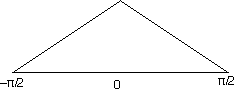
For the symmetry to simplify calculations we extend the problem by declaring that when t=0 and for −∞<x<∞
f(x,0) = −f(x+π,0) and therefore f(x,0) = f(x+2π,0) and f(x,t) = f(−x,t). ∂f(x,t)/∂t = 0.
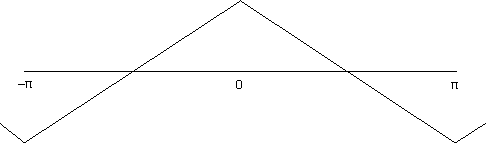
We will conclude that f(x,t) = f(x,−t).
If the string is strung for −π/2≦x≦π/2 and to pluck we pull up the middle (x = 0) to y = 1 and then damp all movement before we release,
the initial boundary conditions for t=0 are:
y = 1+2x/π for −π/2≦x≦0,
1−2x/π for 0≦x≦π/2, and
∂y/∂t = 0.
For the symmetry to simplify calculations we extend the problem
by declaring that when t=0 and for −∞<x<∞
f(x,0) = −f(x+π,0) and therefore f(x,0) = f(x+2π,0) and f(x,t) = f(−x,t).
∂f(x,t)/∂t = 0.
We will conclude that f(x,t) = f(x,−t).
The Fourier series for the initial configuration is
y = ∑ ancos nx summed over positive integers.
Any term in sin nx would violate f(x,t) = f(−x,t).
an = ∫ [−π, π] y cos nx dx/π.
The integral is 0 by symmetry (f(x,0) = −f(x+π,0)) when n is even.
If n is odd then ∫ [−π, π] y cos nx dx/π =
| (4/π) ∫ [−π/2, 0] y cos nx dx | Each quarter of [−π,π] yields same integral |
| = (4/π) ∫ [−π/2, 0] (1+2x/π) cos nx dx | definition of y |
| = (4/π) ∫ [0, π/2] (1+2(x−π/2)/π) cos n(x−π/2) dx | (old x) = (new x)−π/2 |
| = (4/π) ∫ [0, π/2] (2x/π) sin nx dx (−1)(n−1)/2 | n is odd |
| = (8/π2) ∫ [0, π/2] x sin nx dx (−1)(n−1)/2 | factor constants |
| = (8/π2) ∫ [0, nπ/2] (z/n) sin z dz/n (−1)(n−1)/2 | x = z/n |
| = (8/(π2n2)) ∫ [0, nπ/2] z sin z dz (−1)(n−1)/2 | factor constants |
| = (8/(π2n2))[sin z − z cos z][0, nπ/2](−1)(n−1)/2 | Dwight |
| = (8/(π2n2))[sin nπ/2 − (nπ/2) cos (nπ/2)](−1)(n−1)/2 | Apply limits |
| = (8/(π2n2))[sin nπ/2](−1)(n−1)/2 | cos (nπ/2) = 0 for odd n |
| = (8/(π2n2))[(−1)(n−1)/2](−1)(n−1)/2 | sin nπ/2 = (−1)(n−1)/2 for odd n |
| = (8/(π2n2)) | Poof |
f(x,0) = (8/π2)∑ cos(nx)/n2 summed over odd n. This code corroborates these tedious calculations.
(Digression: This is the first proof I learned that ∑ 1/n2 = π2/6.)
This expansion has a curious symmetry between t and x and indeed,
f(x,t) is the height of a square pyramid on the square
−π/2<x<π/2 and −π/2<t<π/2.
In that square f(x,t) = min(1−2x/π, 1+2x/π, 1−2t/π, 1+2t/π).
This is the 2D Fourier series for the pyramid.
At t=1 the string looks thus:

and some numeric corroboration.
Imagine what the topographic map of a pyramid looks like and then contemplate:
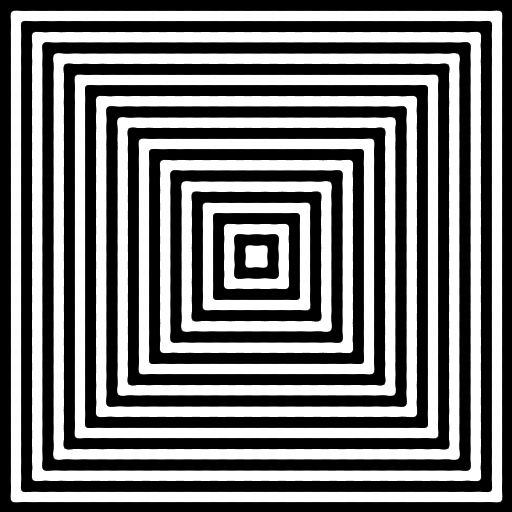
This is a topographic plot of f(x,t).
Each boundary between black and white is an isopleth of constant height (y).
The picture is black at <x,t> if floor(25*f(x,t)) is odd.
There are 25 isopleths and they describe well the square sections of a pyramid.
This Java program made the picture.
The picture above includes terms thru cos(59x)cos(59t).
Below is the same plot with only three terms of the series
(thru cos(5x)cos(5t)).

Note that f(x, π/2) = 0. At t = π/2 the string is straight and all of the energy is kinetic. ∂y/∂t = −2/π for -π/1<x<π/2 but 2/π for π/2<x<3π/2.
Here is a related configuration.